
Understand the difference between Occupancy Certificate (OC), Building Use Permission (BU Permission), and Completion Certificate in Gujarat before buying a flat, house, office, or commercial property.
Buying a property is one of the biggest financial decisions most people make. While buyers usually focus on location, price, amenities, carpet area, construction quality and resale potential, there is another area that deserves equal attention: property approval and completion documents.
In Gujarat, property buyers frequently come across terms such as OC (Occupancy Certificate), BU Permission (Building Use Permission), Completion Certificate, Development Permission and approved building plans.
These terms can be confusing, especially when a builder, seller or broker uses them interchangeably.
For a homebuyer searching for “BU permission Gujarat,” “occupancy certificate Gujarat,” “completion certificate for property in Gujarat,” or “documents to check before buying a flat in Ahmedabad,” understanding the difference can help make the property due-diligence process more informed.
The Gujarat development regulations require a Building Use Permission before a building is used or occupied. The Comprehensive General Development Control Regulations (CGDCR) also require the person responsible for construction to obtain Development Permission before construction and Building Use Permission before using or occupying the building.
At the same time, completion-related documentation confirms that construction has been completed in accordance with the approved plans and applicable requirements. For example, official Gujarat guidance refers to a notice/completion certificate being submitted after the building has been completed as required, followed by inspection and issuance of an occupancy certificate where applicable.
So, what exactly is the difference?
Let’s understand it step by step.
What Is a Completion Certificate?
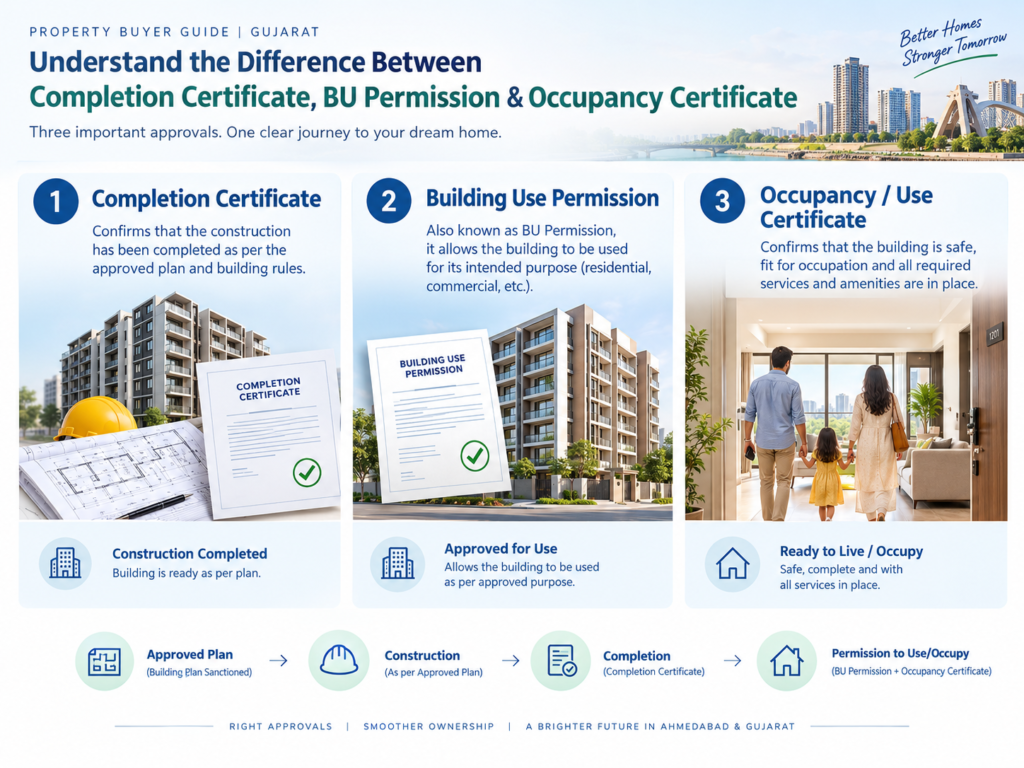
A Completion Certificate (CC) generally relates to the completion of construction.
It is associated with confirmation that the building or development has been completed according to the sanctioned/approved plans and applicable development requirements.
Depending on the authority and nature of the project, the completion process can involve documents, certificates, plans, declarations, and inspections by the relevant professionals and authorities.
The important point for a buyer is:
A Completion Certificate is primarily about whether the construction has been completed in accordance with the approved requirements.
It should not automatically be assumed that a Completion Certificate alone means the building has received permission to be occupied.
Why is a Completion Certificate important?
A buyer should be interested in whether the actual construction corresponds with the approvals.
Important areas can include:
- Approved building plans
- Actual built-up construction
- Number of floors
- Permitted use
- Structural requirements
- Setbacks and margins
- Common areas
- Parking arrangements
- Applicable fire and safety requirements
- Other conditions imposed by the competent authority
GIDC, for example, separately identifies Building Completion Check as a post-construction process and notes that self-certification by an authorised architect is used in its applicable system. It also states that GIDC can conduct verification and take action if discrepancies are identified.
For residential and commercial properties under other competent authorities, the exact procedure and documents can differ.
Therefore, buyers should always verify the documents applicable to the particular property and local authority.
What Is BU Permission in Gujarat?
BU Permission means Building Use Permission.
It is one of the most important terms for property buyers in Gujarat.
In simple language, BU Permission is the authority’s permission for a completed building or applicable part of it to be used/occupied for the permitted purpose.
The CGDCR states that the person responsible for the building must obtain Building Use Permission prior to making use or occupying the building.
This is why a buyer looking for a ready-to-occupy flat, house, office or commercial unit should pay close attention to the property’s BU status.
What does BU Permission tell a buyer?
Broadly, it indicates that the relevant authority has permitted the building to be used for the approved purpose, subject to the conditions and scope of the permission.
For example, a property may have been approved for:
- Residential use
- Commercial use
- Mixed use
- Institutional use
- Other permitted categories
The exact wording and conditions should be checked in the actual BU document issued for the project/property.
Why is BU Permission important when buying property?
Imagine that a buyer purchases a newly constructed apartment because the building appears physically complete.
The building may have:
- Finished walls
- Flooring
- Elevators
- Electricity
- Water connections
- Parking
- Security
- Landscaping
However, physical completion and permission for occupation are not necessarily the same thing.
That is why buyers should not rely solely on the fact that a building looks finished.
The official Gujarat development regulations specifically distinguish construction approval from permission to use or occupy the building.
What Is an Occupancy Certificate (OC)?
An Occupancy Certificate (OC) generally relates to permission/certification that a building or relevant portion can be occupied for its approved use after the applicable completion and compliance process.
In everyday Indian real-estate terminology, buyers and professionals often use OC when discussing permission to occupy a completed building.
The terminology used by authorities can differ. In Gujarat, Building Use Permission (BU Permission) is particularly important, and buyers should examine the actual document rather than assuming that an informal reference to “OC” means a specific document with identical legal terminology.
The broader building-approval framework recognizes occupancy certification after completion and inspection. The National Building Code material available through Gujarat’s disaster-management authority describes completion certification and subsequent occupancy certification, including inspection by the authority. G GIDM
GIDM
Is OC the same as BU Permission?
This is where buyers should be careful.
In practical real-estate conversations, OC and BU Permission may be discussed as serving a similar occupancy/use purpose. However, they should not automatically be treated as identical documents in every Gujarat property transaction.
The terminology, issuing authority and documentation can depend on:
- Location of the property
- Competent local authority
- Type of development
- Applicable regulations
- Project approval framework
- Whether the property is residential, commercial or another use
Therefore, instead of asking only:
“Does this property have an OC?”
a buyer should ask:
“Does this property have the applicable final Building Use/occupancy permission from the competent authority, and can I review the original document?”
That question is much more useful during property due diligence.
OC vs BU Permission vs Completion Certificate: Key Difference
Here is a simplified comparison for property buyers.
| Document | Main purpose | What it generally establishes | Buyer should check |
|---|---|---|---|
| Completion Certificate | Completion of construction | Construction has been completed in accordance with applicable approved requirements | Whether construction matches sanctioned approvals |
| BU Permission | Permission to use the building | Building/use is permitted by the competent authority | Permitted use, conditions, scope and applicable building/portion |
| Occupancy Certificate (OC) | Occupancy/use certification | Relevant building/portion may be occupied subject to applicable requirements | Issuing authority, date, scope and conditions |
The easiest way to remember it
Think of the process like this:
Approval to construct → Construction → Completion/compliance → Permission to use/occupy
The exact documentation and sequence can vary according to the applicable authority and project.
Does Completion Certificate Mean the Property Has BU Permission?
Not necessarily.
This is one of the most important points for property buyers.
A completion-related certificate or declaration concerns the completion of construction and compliance with approved requirements.
BU Permission, on the other hand, concerns permission to use or occupy the building.
The Gujarat CGDCR specifically requires Building Use Permission before using or occupying the building.
Therefore, a buyer should avoid assuming:
Completion Certificate = BU Permission
Instead, verify both the completion documentation and the final permission applicable to the property.
Does BU Permission Mean the Building Is Completely Legal?
BU Permission is an important approval, but it should not be treated as a substitute for complete property due diligence.
A property transaction can involve several other documents and legal checks.
Depending on the property, buyers may need to examine matters such as:
- Title documents
- Previous sale deeds
- Encumbrance-related records
- Development Permission
- Approved plans
- Completion documentation
- BU Permission
- RERA-related project information, where applicable
- Fire and safety approvals, where applicable
- Land-use permissions
- Property tax records
- Society/association documents
- Parking documentation
- Utility-related records
- Litigation or dispute checks
- Mortgage/charge-related documents
The CGDCR also places responsibility on the relevant development actors to ensure that approved drawings and intended use are followed and states that construction documents and intended use should be produced to prospective buyers.
Why Property Buyers in Ahmedabad Should Check BU Permission
Ahmedabad’s rapidly developing residential and commercial markets include apartments, villas, plotted developments, office spaces and mixed-use projects.
For someone searching “property documents to check before buying a flat in Ahmedabad”, BU Permission should be part of the document checklist for applicable completed properties.
Before paying a substantial amount or signing the final transaction documents, buyers should ask:
- Has the building received the applicable BU Permission?
- Who issued the permission?
- What date was it issued?
- What building/project does it cover?
- Does it cover the specific tower/block where the property is located?
- What use is permitted?
- Are there any conditions mentioned in the document?
- Does the completed construction correspond with the approved plans?
- Are there any material deviations or additional constructions?
- Are the seller’s documents consistent with the authority records?
These checks can help reduce avoidable documentation-related surprises.
What Documents Should You Check Before Buying a Property in Gujarat?
A property buyer should look at the transaction as a document verification exercise, not simply a property viewing exercise.
Depending on the property and transaction, the following documents may be relevant.
1. Title Documents
Verify the seller’s ownership and the chain of title.
Ask for relevant registered documents and supporting records.
2. Development Permission
Check whether the project/building was developed under the applicable permission framework.
The CGDCR identifies Development Permission as an approval required before commencement of building construction.
3. Approved Building Plan
Compare the approved plan with the actual property.
Pay attention to:
- Number of floors
- Flat/unit configuration
- Common areas
- Parking
- Building footprint
- Permitted use
- Other significant features
4. Completion Documentation
Check whether the required completion certificate, notice or related documentation has been submitted/issued as applicable.
5. BU Permission
For an occupied or ready-to-use property, verify the applicable Building Use Permission.
This is particularly important because Gujarat’s development regulations require Building Use Permission before the building is used or occupied.
6. RERA Information, Where Applicable
For applicable real-estate projects, buyers should independently verify the project’s registration and disclosures on the relevant official RERA platform.
7. Property Tax and Municipal Records
Check whether applicable property tax records and dues are in order.
8. Society/Association Documents
For apartments, review relevant society or association documentation where applicable.
9. Fire and Safety Approvals
For buildings where fire-safety approvals are applicable, verify the relevant documentation and current status.
10. Other Property-Specific Permissions
Commercial, industrial, mixed-use and specialised properties can have additional requirements.
For example, GIDC separately lists plan approval, plinth checks and building completion checks among its approval processes for applicable industrial properties.
What Should a Homebuyer Ask the Builder or Seller?
Instead of asking general questions such as “Is everything approved?”, ask for specific documents.
Useful questions include:
- “Please provide the Building Use Permission.”
- “Please provide the completion certificate or completion-related documentation.”
- “Please provide the sanctioned building plan.”
- “Which authority issued the permission?”
- “Does the permission cover my specific tower and unit?”
- “What is the permitted use of the building?”
- “Are there any deviations from the approved plan?”
- “Are there any pending approvals or conditions?”
- “Can I verify the document with the issuing authority?”
Written documentation is much more useful than verbal assurances.
Common Mistakes Property Buyers Make
Mistake 1: Assuming a Finished Building Is Automatically Approved
A building can look completely finished while documentation or final permissions still require verification.
Physical completion and regulatory approval are different questions.
Mistake 2: Treating CC and BU as the Same
A Completion Certificate and Building Use Permission serve different functions in the approval process.
Do not rely on one document when the other is applicable.
Mistake 3: Accepting “OC Available” Without Seeing the Document
Ask to see the actual document and verify:
- Issuing authority
- Date
- Property/project details
- Scope
- Conditions
- Applicable use
Mistake 4: Checking Only the Individual Flat
Building-level approvals can be just as important as the documents relating to the individual unit.
For an apartment buyer, verify the relevant tower/building and project-level approvals, not merely the agreement for the particular flat.
Mistake 5: Ignoring Deviations
A buyer should not assume that every visible addition or alteration is part of the sanctioned plan.
Ask whether the actual construction corresponds with approved drawings.
A Simple Example
Suppose you are buying a 3-BHK apartment in Ahmedabad.
The builder tells you:
“The project is completed and all approvals are done.”
Instead of accepting this statement, you could request:
- Approved development/building permissions
- Sanctioned plans
- Completion-related documentation
- Applicable BU Permission
- RERA project information, where applicable
- Relevant fire/safety approvals
- Title and land documents
- Other applicable statutory approvals
You then compare the documents with the actual building.
For example, if the sanctioned documents show a particular number of floors or a particular permitted use, you should verify that the completed building corresponds to those approvals.
This is a more practical approach than relying on the words “approved property” alone.
Why These Documents Matter for Resale and Financing
Property documentation can also matter when you later want to:
- Sell the property
- Transfer ownership
- Obtain financing
- Complete due diligence for a buyer
- Resolve documentation questions
- Establish compliance history
A future buyer or lender may ask for documentation demonstrating ownership, approvals and permitted use.
Therefore, maintaining a complete property document file from the date of purchase can be extremely useful.
Is BU Permission Required for Every Property?
The applicable documentation depends on the property type, location, authority and regulatory framework.
Residential apartments, independent houses, commercial premises, industrial buildings and other developments may follow different approval processes.
Therefore, buyers should not assume that one document checklist applies identically to every property in Gujarat.
For example, GIDC has its own building approval and completion-related processes for properties under its jurisdiction. Its official materials separately identify Building Completion Check and other development-related applications.
For a particular property, the safest approach is to identify the competent authority first and then verify the approvals applicable to that property.
OC vs BU Permission vs Completion Certificate: Quick Takeaway
If you remember only three things from this article, remember these:
1. Completion Certificate
Think:
“Has the construction been completed as required?”
2. BU Permission
Think:
“Has the authority permitted the building to be used for its approved purpose?”
3. Occupancy Certificate
Think:
“Has occupancy/use of the completed building or relevant portion been certified/permitted under the applicable framework?”
Because terminology can vary between authorities and projects, always verify the actual document and issuing authority rather than relying on terminology used informally by a seller or broker.
Property Buyer Checklist for Gujarat
Before buying a flat, house, office or commercial property in Gujarat, keep this simple checklist handy:
- Verify seller’s ownership/title
- Check previous title documents
- Verify applicable development permission
- Obtain the sanctioned building plan
- Compare actual construction with approved plans
- Check completion certificate/completion documentation
- Verify applicable BU Permission
- Check occupancy-related certification where applicable
- Verify RERA details where applicable
- Check property tax and dues
- Check relevant fire/safety approvals
- Review society/association documentation where applicable
- Check for mortgages, charges or disputes
- Confirm permitted use of the property
- Obtain professional legal due diligence before completing the transaction
Final Word for Property Buyers
Understanding OC vs BU Permission vs Completion Certificate in Gujarat can make property buying significantly more informed.
The key is not simply to ask whether a property is “approved.” Instead, identify which authority approved it, which documents were issued, what those documents cover, and whether the actual property matches the approved plans and permitted use.
For buyers in Ahmedabad and across Gujarat, this type of document-focused due diligence can help you make a more informed property purchase and identify questions that should be resolved before completing the transaction.
If you are evaluating a property and want to understand the documentation involved in the transaction, City Address Realty can help you approach the property-buying process with greater clarity.
Speak With City Address Realty
City Address Realty
D-302, Ganesh Glory 11, Jagatpur Rd, near BSNL Office, off Sarkhej – Gandhinagar Highway, Jagatpur, Ahmedabad, Gujarat – 382470
Email: [email protected]
Mobile: +91 7600035590
Disclaimer: This article is intended for general informational and educational purposes. Property approval requirements and terminology can vary depending on the local authority, property type, project and applicable regulations. Buyers should verify original documents with the competent authority and obtain independent legal/technical advice before purchasing property.